

Dear Readers,
April is known among Civil War historians as the bookend month: It begins with the Confederates firing on Fort Sumter on April 12, 1861 and ends five years later with the decisive events in the final three weeks of 1865: April 9, General Robert E. Lee surrendered the Army of Northern Virigina to Uyslesse S. Grant; April 15, Abraham Lincoln was assassinated; April 26, General Joseph E. Johnston surrendered the Army of Tennessee to General William Tecumseh Sherman in North Carolina, effectively ending the last major organized fighting of the Civil War. I thought that this is something to be considered during these current days.
The danger of serendipitous reading is that you can find yourself entangled in a subject you never thought you needed to know about. Slowly, you begin to realize that you want to know more. If you are the slightest bit obsessive, the normal rhythm of your day pauses as you follow the subject’s threads, one right after the other. This is why I now know many new things about the Civil War, such as how to amputate a leg (or arm) and the recipe that helped to lower mortality rates among Union and Confederate soldiers.
It all began when I decided that it was high time to pay attention to my toes and nails. I don’t like sitting still for the time it takes so I went looking for something to read and picked up whatever magazine was near the top of the pile on the table. Once settled in the chair, feet submerged in scalding water, I opened the magazine to a review of a new edition of the Civil War diaries of George Templeton Strong. I knew nothing about him, but the first few paragraphs were a good start. Strong was a prominent, civic minded, well-connected Wall Street lawyer, and his diary is considered one of the most important personal chronicle of the Civil War. His is a behind-the-front line record as the review pointed out: He was drafted in 1863 at the age of 43. Like many wealthy men, he took advantage of a provision in the country’s first draft law that allowed him to find a man to take his place—in his case, a young Dutch immigrant who he paid $1,100, about $28,528.60 today. (There’s no news about how the young man fared.) Still, as the review underscored, he went on to make an important contribution to the war effort than he could ever have made as a soldier.
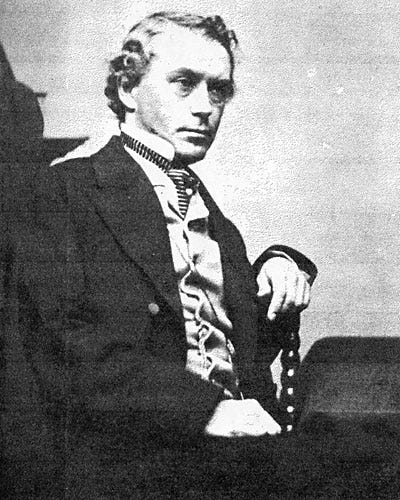
Strong helped to create and manage the United States Sanitary Commission, which built, staffed, and supplied hospitals and battlefield medical facilities. He served as the Commission’s Treasurer and, with his business contacts and vast monetary experience, he was able to accomplish one of his most pressing tasks of securing a continuous supply of fresh food. Soldiers can find shelter in the meagerness conditions, but they cannot fight if they are starving, ill, or wounded. Scurvy was among the most serious afflictions on both sides of the conflict and a remedy for the disease appears in several of Strong’s diary entries: Cabbage—cheap, easy to transport and source, and, most importantly, packed with vitamin C, fiber, and antioxidants—proved to be an effective treatment.
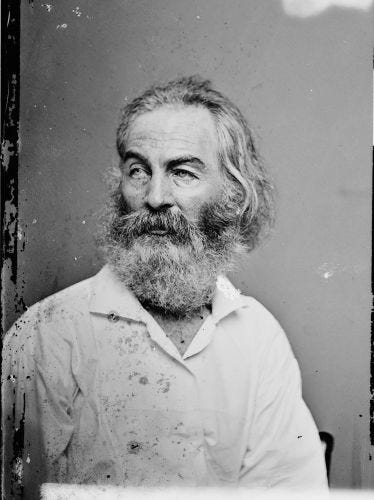
Half way into the review, the writer brings in Walt Whitman’s Specimen Days (1882), noting that the poet had first-hand experience with the Commission through his volunteer work as a nurse in hospitals in Washington and in surrounding battlefields. My knowledge of Whitman is limited to a sophomore college American poetry class. So I went on a new tangent and discovered his non-fiction work, which includes journalism, essays, and memoirs. Specimen Days is his major prose work, a collection of sketches of people, historical events, thoughts about nature, and reflections on his youth and old age. A large portion of the book is about his Civil War years. Back home from the salon, I asked my husband if he knew whether we had a copy of the book. At this point, the house’s bookcases are a living record of many of mine and his own serendipitous adventures in bookstores, thrift shops, and yard sales. He suggested it might be on the bottom shelf of a small bookcase in the back of the house.
The found book earned him a few nightly readings of passages especially while he was trying to fall asleep. My favorite is one in which Whitman takes an evening walk around the battlefield at Chancellorsville after the armies’ first engagement (April 30, 1863):
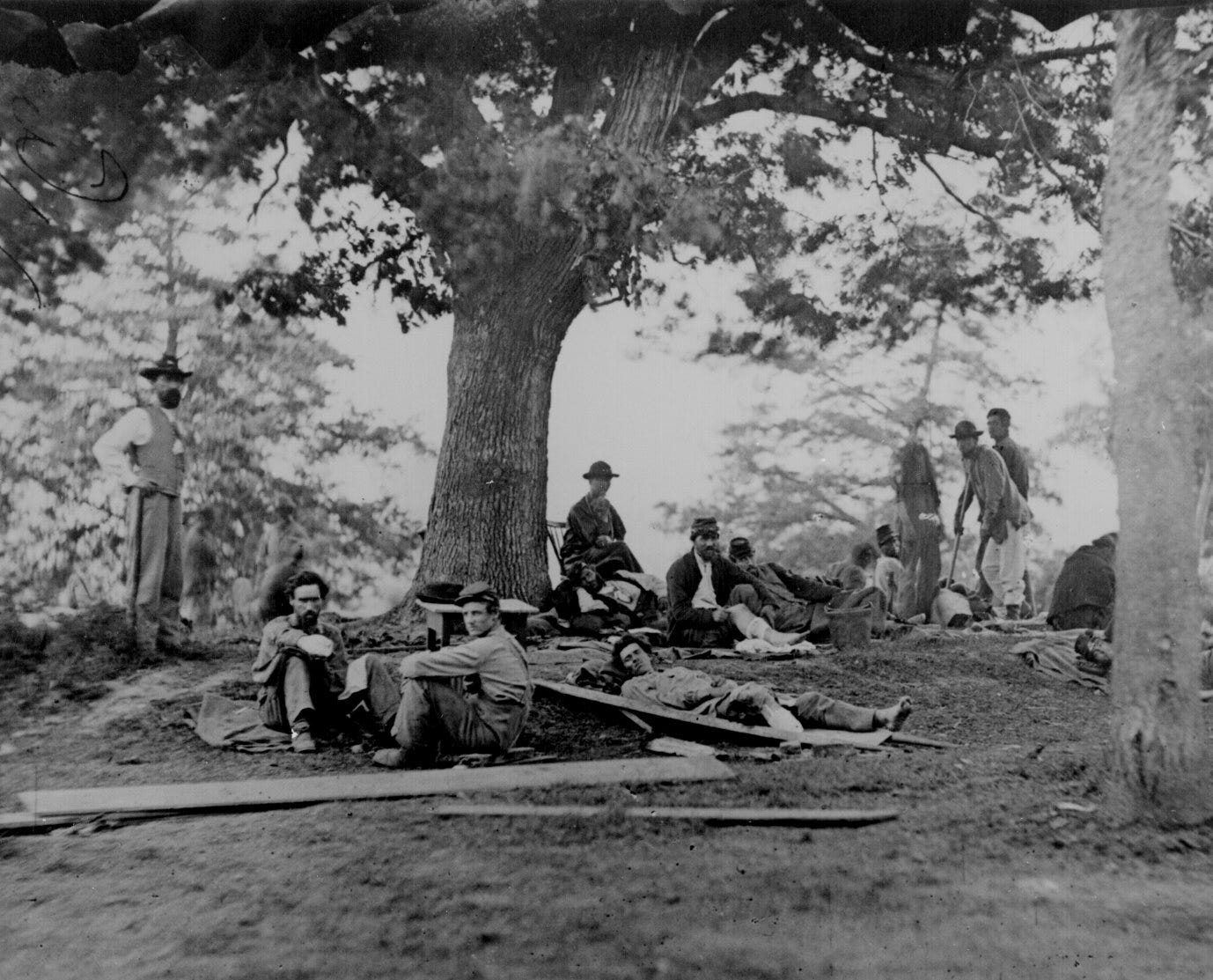
The night was very pleasant, at times the moon shining out full and clear, all Nature so calm in itself, the early summer grass so rich, and foliage of the trees—yet there the battle ranging, and many good fellows lying helpless, with new accessions to them, and every minute amid the rattle of muskets and crash of cannons, (for there was an artillery contest, too,) the red life-blood oozing out from head to trunks or limbs upon that green and dew-cool grass.—Walt Whitman, Specimen Days
Soon after, came this:
The war itself, with the temper of society preceding it, can indeed be best described by that very word convulsiveness.—Walt Whitman, Specimen Days
And I ended with Whitman’s thoughts, soon after President Lincoln’s assassination:
One falls, and another falls. The soldier drops, sinks like a wave–but the ranks of the ocean eternally press on. Death does its work, obliterates a hundred, a thousand–President, general, captain, private–but the Nation is immortal.—Walt Whitman, Specimen Days
To learn more of what Whitman experienced among the wounded, I turned to Samuel D. Gross, one of the country’s most prominent trauma surgeons. At the start of the war, the United States Surgeon Office asked him to write a small book to provide guidance and standardize medical practices among the army divisions, A Manual of Military Surgery or, Hints On The Emergencies of Field, Camp, and Hospital Practice (1861). The book proved so useful that a copy of it was filched by the south and reprinted for use by Confederate medical officers. (One of my brothers-in-laws had given me a copy as a Christmas present a few years ago. It was languishing on a shelf behind my desk.)
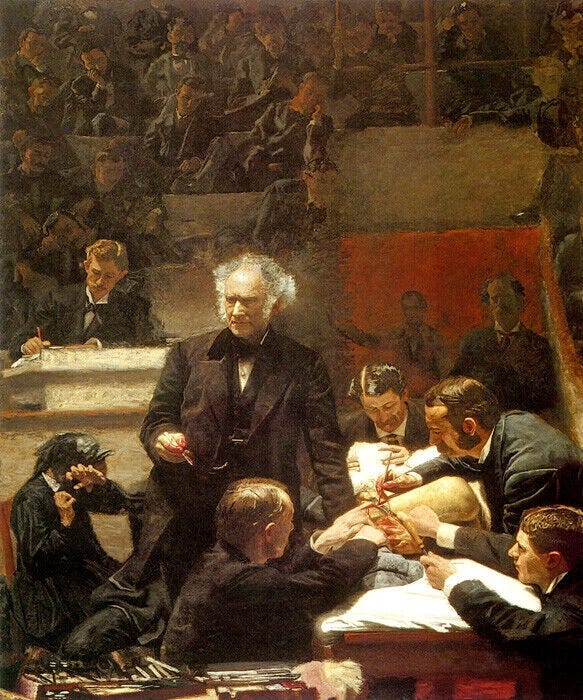
Gross’s book is all encompassing, detailing the correct personal characteristics of a good surgeon and nurse that included steadiness, fleetness in decision making, and firm ethical standards on and off the battlefield. He underscored correct surgical procedures, different methods of amputations, and the various treatments and prognoses for injuries to organs and the head. The medicines he insisted be on hand were mostly homeopathic—hellebore, juniper berries, agrimony, rhubarb, and the like. Some doled out mercy: opium, chloroform, ether, gin, brandy, wine, and aromatics spirits (smelling salts). Others were just plain dangerous but typical treatments for the time: arsenic, mercury, acid of nitrate, turpentine. Gross wasn’t convinced that the use of sterilization and antisepsis before and after surgery helped with recovery but he was adamant that food played a major role in the success or failure of a patient recovery.
Immense suffering and loss of life are often occasioned for the want of fresh vegetables and fruits in military operations as well as in the garrison and the hospital….The diet of the sick-room has slain its thousands and tens of thousands. Broths, and slops, and jellies, and custards, and ptisans are usually as disgusting as they are pernicious. Men worn out by disease and injury must have nutritious and concentrated food.—Samuel Gross, A Manual of Military Surgery or, Hints On The Emergencies of Field, Camp, and Hospital Practice
His notebook ends with 15 recipes common to invalid cooking, starting with a standard beef tea and moving on to chicken broths and jellies, vegetable soups, gruel and arrowroot pap fortified with Maderia, Port and Sherry, flavorful sargo jellies, and drinks such as lemonade and apple vinegar.
The life of a man is in his food.
And here I am, at last, deciding to lay the Civil War to rest, after multiple drafts, a desk full of books, and a medium-size pot of cabbage stew on the stove. I hope you’ve enjoyed the journey!
Please press the little heart below (and at the top) to let Substack know you value Stories!

Recipes
Civil War Curry Cabbage Stew
Note: I started to look further into the stew’s origin. Curry made me think it’s was influenced by West African slaves in the Caribbeans and could have been brought up to the country through the slave markets. But this new line of inquiry was leading this piece to be even more delayed and longer than it already is. I’ll come back to this question sometime later.
1/4 pound salt pork (fatback), chopped into cubes
I medium size head of cabbage, chopped
2 medium onions, chopped
To taste: salt, pepper, ground red pepper (or curry powder), garlic salt.
Fry the cubes of salt pork in a large, hot cast-iron pot until well browned.
Lower the heat and add the chopped cabbage and onions.
Cook over low heat for about 1 hour or until the vegetables are wilted and soft.
Add your preferred amount of salt, pepper, and garlic salt.
Serve with more red pepper or hot sauce for individual taste.
The following two recipes are for 1 serving.
Beef Tea
Beef tea was the mainstay of an invalid’s daily meny, thought to contain much needed protein. Essentially a homemade bouillon, it fell out of favor when more convenient commerical products came on the market. It’s made a come back recently.
1/2 pound top of round steak
1/2 pint cold water
1/3 level teaspoon kosher salt (optional)

Cut the meat into small pieces (the smaller the pieces, the more easily the meat will will give off its juices, or you may scrape the meat from the fibers). Place the meat in a medium-size bowl and add the cold water. let stand for half an hour.

Pour the meat and the liquid into sa medium-size sauce pan and slowly bring to a low boil. lket it simmer for 1 hour. Add more water if needed.

Strain and season with salt if preferred.

Beef tea may be served hot or frozen which can be very pleasing to relieve sore throats.

Store no more than for 1 day.
Oatmeal Gruel
This is the basic recipe for gruel. Consider at what stage of recovery your patient is and adjust ingredients accordingly. For instance, if the stomach is delicate, make the gruel with more water than milk. If the illness is in the recovery stage, consider adding flavoring. You may also want to bulk it up with fruit.
1 cup water or milk (or half of each combined)
1/4 teaspoon kosher salt
2 tablespoons Irish oatmeal (rolled oats will do but Irish oatmeal is more flavorful)
In the top of a double boiler, bring the water or milk (or both) and salt to a boil and stir in the oats. Cook for 15 minutes.
Place the pan over the bottom of the boiler and cook over gently simmer water for one hour.
You may strain the gruel through cheesecloth for a more smooth consistency or leave as is. Add a pinch of cinnamon or a little jelly to flavor.
Arrowroot Paps
2 or3 medium-sized Arrowroots, peeled and washed
1 to 2 cups milk, depending on desired thickness
Sugar, honey, or condensed milk to taste.
Peel, wash, and cut the arrowroots into small pieces to facilitate quick boiling.
Place the pieces in a pot with water and boil until soft and tender (a fork should pass through easily).
Allow the boiled arrowroots to cool in the pot then transfer them to a blender and add some milk. Blend until smooth and creamy.
Pour the mixture back into the pot over medium heat. Add the remaining milk to adjust the consistency.
Stir in your preferred sweetener and bring to a boil for a few minutes, stirring continuously to prevent sticking at the bottom.
Serve hot.
Sago Cream Jelly
This may be considered a dessert but it’s use in the sick room was to restore a patient’s desire to eat. It is light on the stomach and somewhat nutritious.
1 cup Sago pearls
1 quart water
1 quart milk or heavy cream
8 egg yolks
1 cup sugar (or to taste)
1 grated lemon rind
Soak the sago in cold water for an hour, then strain.
In a medium pot, bring the quart of water to a boil, add the sago, and simmer slowly, stirring often, until the pearls are transparent and the mixture is thick.
Pour in the milk and add the lemon rind. Bring the mixture back to a gentle simmer, stirring to prevent burning.
Beat the egg yolks with the sugar in a medium size bowl. Remove the sago pot from heat and slowly stir in the egg mixture. Return the pot to the stove and heat briefly to thicken. Be careful not to boil or the eggs will curdle.
Pour the mixture into a mold or bowl and let it stand in a cool place to set completely before serving.
Serves 6.
Pat, I love this--and love the idea of you, pulling narrative threads while you boil your toes. Wondering: Do you know Ken Burns' Civil War saga? He uses Strong as a narrator throughout, with George Plimpton reading diary passages. Also, to add to your recipes: in the absence of coffee, many in the South resorted to yaupon holly--the only caffeinated plant native to North America. I've brewed it. Acquired taste, but if you need the caffeine . . . ☺️
It's a wonder that anyone survived a serious wound during the Civil War. Some of those recipes are pretty wild, but sound nutritious. My mother's grandfather fought for the north during the CW. You've inspired me to dig out his military records.