
For the Birds
Or how my house has become a favorite layover for some of the 350 different birds that are currently flying through Brooklyn.

Please tell Substack that you care about my writing by pressing that little heart button above!

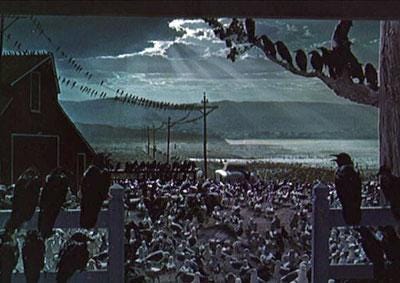
Do you remember the final scene of Alfred Hitchcock’s movie, The Birds? The family walks out of their house and down the porch steps, navigating slowly to their car through a mass of squawks, shreiks, and fluttering wings. The landscape before them choaks with birds.
This is my backyard.
It all began one July morning while we were staying at our tiny cottage in the woods. The blossoms on the old Rose of Sharon outside the window began to tremble.
My husband, who was having breakfast at the table, whispered urgently, “hummingbirds!”
Sure enough, hummingbirds fluttered at the heart of almost every blossom, all blurry wings and tiny heads burrowed deep inside, enjoying its own breakfast. Even if their visits sometimes tores the blossoms loose, the hummingbirds were a miraculously dazzlingly sight to behold.
Later that afternoon, my sister and I were sitting out on the deck, enjoying our after-work martinis while dissecting the long list of our family’s foibles. The background noise of birds settling in the surrounding trees for the night was not particularly noticed or feared: we were in the woods, what did we expect? But as daylight dimmed, the chatter grew louder and the surrounding foliage seemed to darken and hang heavier with bird gatherings. A few big birds perched on the house’s peaked roof.

My sister pulled out her phone.
“What are you doing?” I asked.
She shushed me. A few minutes later she handed me her phone. “Here,” she said, showing me Merlin, the app she had opened. Developed by the Cornell Lab of Ornithology, Merlin helps identify birds the world over. Right then, it was busy recording all the birds that were swooping around us: Wrens, starlings, blue jays, thrusts, warblers, sparrows, blackbirds.
“Oooohhhh,” she said taking her phone back. “We got something called a ruby-crowned kinglet!”
The next morning, I found my sister sitting at the table with her breakfast and watching the hummingbirds. She had Merlin open and when I sat down, she slid her phone over to me.
“Our three a.m. caller,” she said.
This is when I thought about hanging a couple of bird feeders to bring on more visitors. But then my neighbor reminded me about the foxes, deers, squirrels and—most certainly—the assertive neighborhood bear. They would maul the feeders and devour everything in them before the birds even had a chance.
But when we got back from the woods to Brooklyn, I bought two feeders where I imagined the only interloper would be the neighbor’s pampered cat. A possum family may wander through but I hadn’t seen one all summer.
By the end of the week, the feeders were fixed to old metal poles once used to string laundry lines. They overflowed with a tasty variety of seeds from the 50 pound sack I bought at Home Depot.
For most of the afternoon, my indoor cat and I stood at the back door, waiting. Squirrels dangled upside down from the poles to snatch seeds. They eventually moved along when a group of starlings and sparrows appeared mid-morning. Later in the day, a pair of mourning doves joined forces with a great creasted flycatcher to peck through the dirt in the plant containers looking for hibernating bugs. There are many pigeons about but they’re not interested in my feeders. They’re too busy flying in swooping formations on practice runs over the park or the many neighborhood rooftop pigeon clubs. The squirrels returned around dinnertime, settling for the less arduous method of scavenging for the day’s discards on the ground. Word of the feeders got out over the next few days and birds of all sizes and depositions descended from the sky. The battles for access to one of the perches were pretty thrilling. Honors went to a blue jay, several titmice, and a pair of cardinals. My cat and I decided they were the neighborhood bullies.
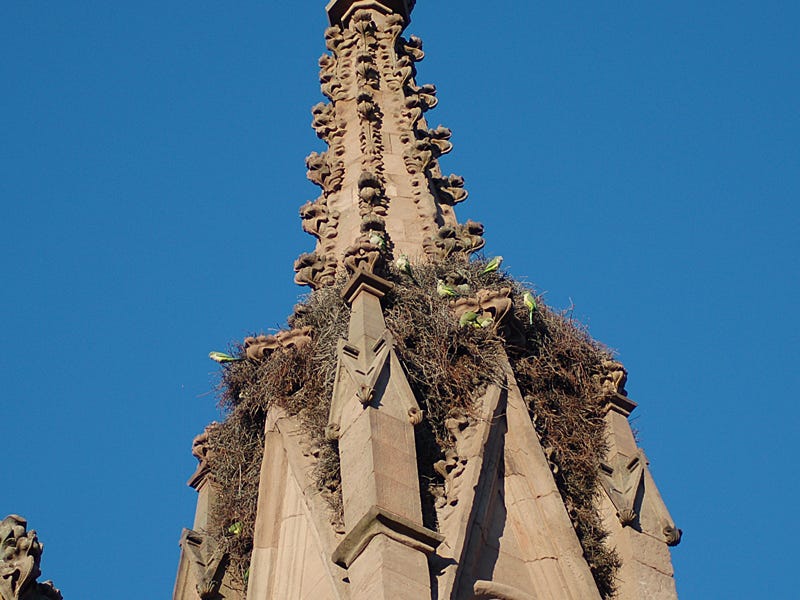
There are about 350 native birds in New York City that swell to over 500 during the migration seasons of March through October mainly because of its envious landscape, starting with the Atlantic ocean, and moving on to marsh land, ponds, rivers, reservoirs, forests, and parks. Peregrine falcons have made a very remarkable come back, drawn to the vast number of tall buildings, especially the skyscrapers surrounding Central Park, where they nest. The park is their Whole Foods market stocked with wildlife. Then there are monk parakeets: Very colorful, huge in number, incorrigible builders of long, dense nests usually crammed behind sport fields light which provides the South American natives with much needed warmth. Unfortunately, the nests occasionally catch fire. They often use the protective crevices of quiet cemetery buildings and monuments, but the structures tend to slowly crumble because of their droppings and then the birds are kicked out and have to look for other real estate.
Early one Sunday morning, our cat sprinted off my stomach, ran to the window and, repeatedly threw himself against the glass with purpose: a small bird had crashed into my uncharacteristically clean window. A Google search instructed me to place the bird in a box with a lid and immediately find a bird rescuer. All the nearby ones I called were full and each directed me to the bird and wildlife sanctuary in Manhattan. My husband couldn’t believe he had to change out of his pajamas to drive to the Upper East Side on a beautiful Sunday morning with a bird in a shoe box that he considered almost dead. The woman in scrubs who met us at the sanctuary door came back a few minutes later. Our bird, a black-capped chickadee, was doing just fine.
As my visitors increase in number, so do their white and brown droppings, which speckle all the cars within a three house radius. This occasionally draws complaints from neighbors. I tried to cheer them up by telling them the Irish believe bird droppings bring good luck, especially when they land on you. This did not change their opinion on the situation.
In addition to droppings, birds are messy eaters. The squirrels appreciate the mounds of cracked sunflowers beneath the feeders, but I do not. I’m half expecting a bumper crop of sunflowers to uproot the garden’s brick path.
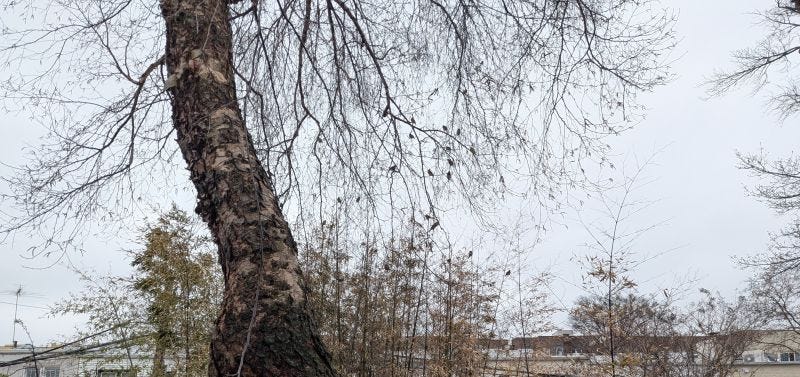
And then there is the tall stand of bamboo I planted along the back fence. It provides the birds with shelter from winter’s appalling weather and is an effective hiding spot from the neighbor’s cat whose stalking skills have improved since I hung the feeders. It is amusing, though, to observe how much it drives him crazy when the birds alight on the tallest bamboo stalks. They proceed to chatter among themselves at a decibel that might raise the dead while the cat fails one climbing attempt after another.
Mourning doves shun the bamboo and prefer our neighbor’s thick trumpet vines entwined along the top of our shared fence. They sit in distinct couples, two by two, by two, and wait for the time when other birds have momentarily assuaged their hunger. Then they float down off their perch and murmur among themselves as they leisurely stroll about picking at seeds that have fallen onto the brick path. Mourning doves are either exceptionally brave or brazenly stubborn because they are perfectly content to make you walk around them. Once, they even kept their ground when a red tail hawk descended from the sky and began to circle lower and lower above them. All the other birds took flight to their bamboo shelter. I decided I really didn’t want to see the threatened carnage and opened the door to put the hawk off his hunt. The mourning doves didn’t flinch at all.
[AI fun fact about mourning doves: “Their appearance is widely interpreted as a spiritual message of peace, love, hope, and comfort. It is commonly seen as a visit from a departed loved one, a sign of encouragement during difficult times, or a reminder of divine presence, offering a moment to find stillness.”]
All of my visitors are beautiful and majestic, their command of the garden spellbinding. But if I’m being truthful, it’s unnerving how the birds have so quickly taken over the small garden. We are reluctant to walk down into it. We allow them to command the tree and begin to spoil the new garden table. Our small house in the woods, surrounded as it is in a vast forest, allows the birds to happily cohabit with us. In the city we are crammed together, each surrounded by all kinds of dangers.
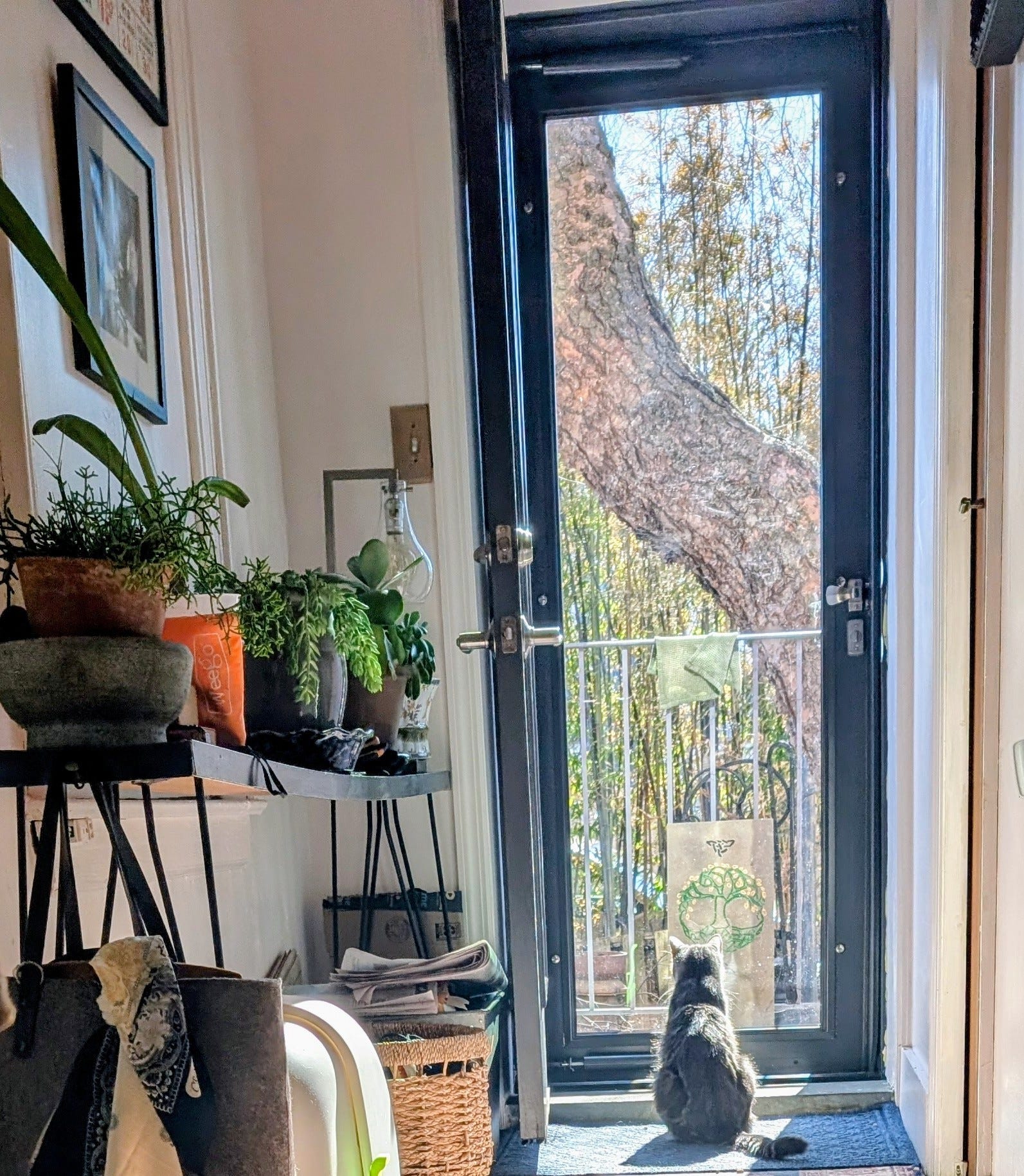
Sometimes the cat and I stand at the back door together and watch in silence. Merlin has recently tallied 126 different species–including one owl that kept me company during one long sleepless night.
I would be remiss if this story did not include the most famous bird recipe, the Medieval, Four and Twenty Blackbirds Pie. Much of the period’s cooking is short on flavor except if you were of noble blood. Then you had access to all the spices and herbs coming back from the Crusades. At the very least you probably had household servants dedicated to amusing you. Blackbirds pie is one such amusing effort. It would be nothing but a hard, bland casing if not for the presence of live birds released after the crust was cracked.
I found a delightfully easy recipe on Emily Hilliard’s terrific blog, Nothing in the House. (The range of pie recipes she offers is worth book marking her site for future baking.) The blackbirds recipe is originally from Epulario or The Italian Banquet by Giovanni de Roselli, (1549).
An added joy is the recipe’s very charming illustration by Elizabeth Graeber. I am deeply indebted to both women for their permissions to reprint their work!
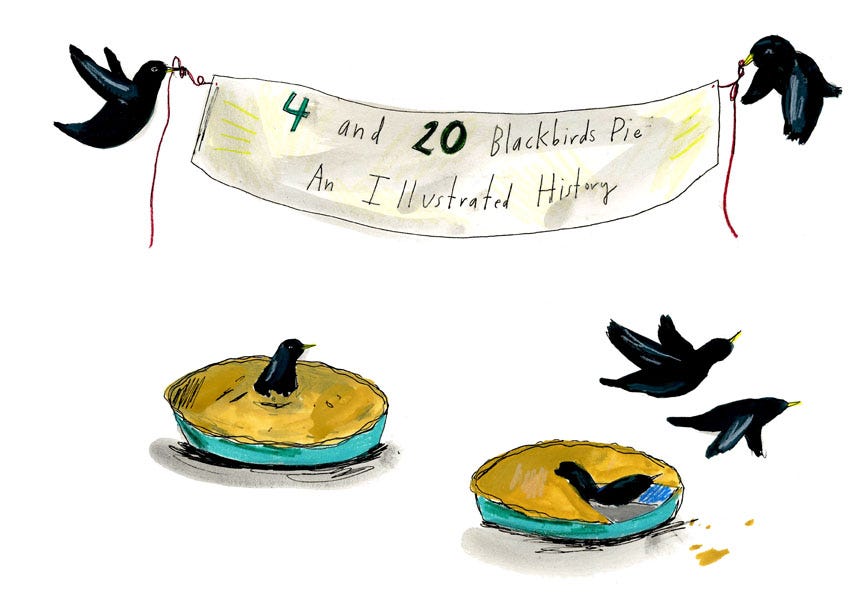
Four and Twenty Blackbirds Pie on The Hairpin!
TO MAKE PIE THAT THE BIRDS MAY BE ALIVE IN THEM, AND FLIE OUT WHEN IT IS CUT UP
Make the coffin of a great Pie or pastry, in the bottome thereof make a hole as big as your fist, or bigger if you will, let the sides of the coffin bee somewhat higher then ordinary pies, which done put it full of flower and bake it, and being baked, open the hole in the bottome, and take out the flower. Then having a pie of the bigness of the hole in the bottome of the coffin aforesaid, you shal put it into the coffin, withall put into the said coffin round about the aforesaid pie as many small live birds as the empty coffin will hold, besides the pie aforesaid. And this is to be done at such time as you send the pie to the table, and set before the guests: where uncovering or cutting up the lid of the great pie, all the birds will flie out, which is to delight and pleasure shew to the company. And because they shall not bee altogether mocked, you shall cut open the small pie, and in this sort you may make many others, the like you may do with a tart.
Two things before you go:
Stories needs your help to continue its publication. Please consider signing up for a paid subscription and/or sharing it far and wide among your friends and family!
As always—thank you from your grateful writer! ~ Pat
The city birds, the four-and-twenty-blackbirds, the app, what a great post, Pat! (I have a ceramic pie bird 🐦 for venting — the pie, not myself 😆)
Fascinating story about your country and city birds! I can't imagine seeing all those hummingbirds.