

You go to the movies on Saturday afternoon and order a small bag of popcorn. Your husband devours most of it as he usually does and his stomach grouses all the way home. Dinner becomes scrambled eggs since he’s not that hungry. A heavy dose of Gaviscon settles his stomach before he lies down to sleep. The next time you see him it is three a.m. and he’s on the floor in a happy baby yoga pose that’s supposed to help relieve a gassy stomach. You ask if he’s alright. He says sure. You believe him and go back to sleep. It’s around eight a.m. when you wake. He’s in the living room staring at his tablet. After happy baby didn’t help he turned to medical sites. They all, especially WebMD, agree that maybe his appendix is about to burst. He’s scheduled a video chat from a doctor at your local hospital. She soon calls, listens to his symptoms, asks a few questions, and says he should immediately go to the hospital. It’s painful to watch him slowly pull on his jeans and a shirt but he refuses help. At least they’re clean, unlike your sweats, but looking decent isn’t your major chore. You have to pull together a survival kit:
Emergency Room Survival Kit
Water—one for each person taking the trip with you.
Food—concentrate on comfort. Personal favorites include fruit, cookies, and a whole bunch of chocolate.
Your phones, chargers, and earbuds.
Money—lots of money—and your medical insurance cards.
Optional: ancillary reading materials in case your phones dies and you can’t find a plug.
You are now ready for your emergency room adventure.
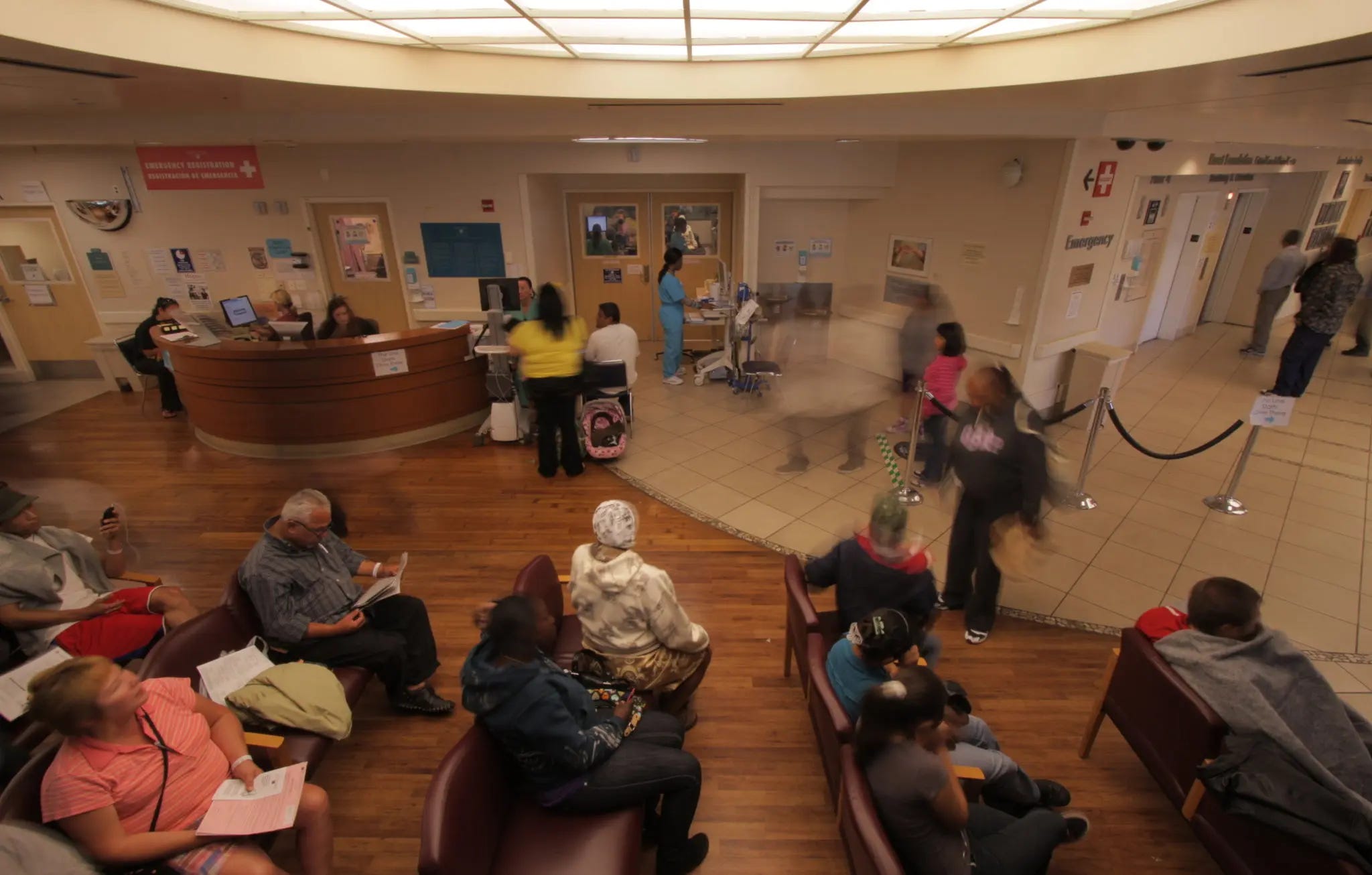
The nearest hospital is a level 1 trauma center. This means that unless you’re bleeding profusely or possibly expiring, you are directed to the uncomfortable plastic chairs in front of the reception desk. It is not unusual for it to be standing-room only, filled with obviously distressed people, some of whom are screaming babies. But it’s early Sunday morning and you luck out that there are only seven sufferers and one baby in relativity good humor. Your husband’s name is called before you settle in and you trail behind him into the intake room. A nurse records his vital signs while asking him questions, none of which he answers correctly. Your intervention raises a laugh from the nurse but she doesn’t share his blood pressure and heart rate scores when you ask. He is immediately wheeled down a long hallway, past several large nurses stations, patients in curtained cubicles, and more patients in beds lining both sides of the hall. Your husband is placed in the final cubicle where a young man lies motionless, his eyes closed. It must be his mother who sits in a chair at the foot of his bed, one hand resting across his legs. Neither seem to register that your husband will occupy the empty bed across from them. You help your husband into bed, then take your place opposite the young man’s mother.
And the waiting begins.
9:27 a.m. A cheerful child of God sits right outside your cubicle. He volunteers that he’s 305 pounds and has been here since the day before. The nurses know him from previous visits and come by to see how he’s doing. “May the father, son, and holy ghost protect you,” he calls to you. “Pray with me now!” Your husband has the excuse of feeling lousy. It’s been a long time since you’ve talked to God but his smile is the most beatific you’ve seen in a long time and you try your best.
10:04 a.m. (Approximately) Somewhere out beyond your curtain comes a string of inventive curses. A peek outside reveals a man in one of the beds parked in the hallway holding forth to a clearly irritated nurse. “I told you, no grandmother, no going home,” she says. This does nothing to calm her patient. After he rants for another minute, a male nurse sharply cries, “dude!” The grandmother’s grandson stops shouting and the nurse kindly says, “how would you like some Jell-O?”
10:18 a.m. A nurse comes in and introduces herself as your husband’s nurse. She gives him a gown then drains him of many tubes of blood. After she leaves, you hand him his phone and you open your book, settling in for the long haul.
11:45 a.m. Your husband’s roommate opens his eyes but still doesn’t move. His mother goes to him. A nurse comes by with a box lunch. The young man looks down at it: banana, apple juice, something in a styrofoam cup, possibly soup. “I don’t want it,” he says. His mother responds in Spanish and he replies back. The one word you understand is “pozole,” only because you’ve ordered it from the neighborhood’s food truck. “No,” she says softly and begins to massage his leg.
12:22 p.m. (or there about) You are returning from the bathroom when you glimpse into the neighboring cubical and see an old woman and two people who you guess are her son and daughter. There’s also a doctor:
Son: “We need to get her out of here. She’s going crazy.”
Mother: “I’m not crazy.”
Daughter: “She’s not crazy, believe me. But she will be if she doesn’t go home.”
Doctor: “We want to watch her overnight.” Then he turns to their mother: “What do you want to do?”
Mother: “Have a party.”
Doctor, laughing: “She’s not crazy.”
Mother: “Dewar’s on the rocks.”
Doctor: “Certainly not crazy.”
The doctor hurries past, not noticing you at all.
12:33 p.m. The same doctor appears in your cubicle along with a nurse to talk to the young man. His mother stands up to be closer to them. “I know this sucks,” the doctor says. “You just have to deal with it for a little while longer. We want to get you back on the basketball court.” The nurse translates for his mother. The doctor smiles at the young man’s mother. “His numbers are up. Good sign.” The nurse rubs his mother’s arm while giving her the news. And then the doctor and the nurse leave. The young man closes his eyes once more and his mother returns to her seat, her hand returning to rest on his leg.

12:49 p.m. Your husband goes off for a CT scan. He wants something to eat when he returns but nothing in your kit appeals to him. You leave to wander through the halls until a guard shows you the way to the hospital’s cafe. It is a perfect facsimile of everyone’s favorite diner. There’s a long, curved lunch counter and comfortable booths upholstered in bright orange vinyl by the windows looking out across a low roof crowded with air conditioner units. There’s even a small revolving pie display case with slices of apple, coconut cream, and lemon merginge pies. You don’t want to take too much time and decide to buy two ready-made half sandwiches (tuna fish and a turkey), thinking you’ll come back for pie later.
1:20 p.m. Nothing has ever tasted as good as these sandwiches. “Go take a walk,” your husband says after you clean up the mess on his bed. You don’t want to—what if something goes wrong and you’re not here? “I’m not going anywhere,” he says. He is very certain about that. You are not. But you pull on your jacket because it’ll make him happy.

1:37 p.m. You walk out the emergency room doors and into the day’s cold gray drizzle. The area around the hospital was once a busy port. Now, decaying wooden piers slouch into the East River. Railroad tracks still cut through the cobblestone streets running before massive manufacturing warehouses. Over the last decade, the buildings have transformed into high-end design studios, architecture offices, furniture showrooms, and artisan lofts. Since it’s Sunday no one is around except three prostitutes in thigh-high leather or pony-hair boots, and impossibly short skirts. One wears a satin Knicks jacket (it’s the playoffs). Another’s long thin black coat flies away from her body in the wind. The third is your favorite—sheathed in a tight hip-length jacket made with what appears to be white duck down, the feathers increasingly matting in the mist. She is the one on the phone and when someone answers, she shouts, “WE’RE IN THE RAIN.” The Knick’s fan leans over her shoulder: “MY HAIR IS RUINED.” Their friend shelters in one of the warehouse’s open bays, taking selfies for her Instagram account.
2:06 p.m. In the short time you were away, occupied beds have created a traffic jam in the hallways. Some people are moaning. Some sit in wheelchairs connected to IV lines and scrolling on their phones. Some, like one ranting, shirtless, muscular man, has had it with everything in his life. Even though he’s handcuffed to the bed rail, a policeman pins his arm down:
A nurse says to the policeman, “What did he do?”
“Stabbed his dad. Twin brother slugged him.”
“All kinds,” the nurse says and quickly inserts into his arm an IV needle.
The man rears up. “What the fuck!”
“Give him ten minutes,” the nurse says to the policeman and walks away.
The policeman continues to hold the man down.
2:11 p.m. When you return to your cubicle, you find a doctor explaining to your husband his options: surgery or a heavy course of antibiotics. The surgery comes with complication. The antibiotics might not work. What the hell, surgery it is! The doctor says if your husband hadn’t eaten his sandwich they could have done it right away. Now, he’ll probably see him tonight around 10—10:30 at the latest. Your ever optimistic husband exclaims, “we’ll be home by midnight,” right before his nurse comes in to relate that he will be admitted for the night.
2:30 p.m. From then on, all there is is the passing of time. The young man’s mother is relieved by his sister. They are astonishingly beautiful siblings: black hair, fine cheekbones, whispering to each other with lilting voices only they grasp. Occasionally, she speaks to friends or her mother on her phone, but she always keeps her gaze on her brother. You try not to listen, try not to even glance over at them. They do the same for you and your husband. There could be a wall between the beds, an illusion of having privacy to bear the weight of this sudden burden.
7 p.m. The evening’s nurses arrive and introduce themselves. The young man’s is a brisk woman who calls him sweetie while checking out all the tubes he’s connected to. Yours is a laid-back man who, from the heckling thrown by passing nurses, is well-liked. The first thing he tells you is that your surgery has now been pushed to midnight. “From one to ten, what would you say your pain level is?” he asks your husband. He replies eight. “What do you say to oxycodone?” Your husband brightens. The small pill quickly arrives.
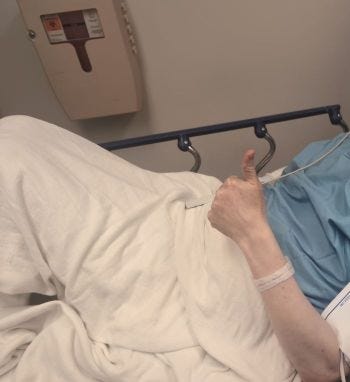
7:15 p.m. Holy moly, does oxycodone release a tsunami surge of elation! Your husband babbles all kinds of wonderful ideas and life observations. There’s something about going on the road with Jerry Steinfeld. Several nonsensical ideas for Op-Ed pieces come to mind that he’s sure The New York Times will love: “I gotta write them down!” (You do not give him your notebook.) For a good two hours he is full of creative light and joy. No wonder this stuff drives people crazy. Thankfully, he mellows before he rips out your final nerve. Gratefully, he doesn’t want another dose.
10:30 p.m. The young man’s sister quietly says that her brother would like to sleep. Is it alright to turn out the lights? Of course it is, you say. The nurses station becomes a nightlight for your darkened room. The young man’s sister prepares to leave and murmurs, “good luck,” in such a comforting way. “You, too,” you say, hopefully encouraging. You will watch over her brother now.
11:12 p.m. The surgery is called off until the morning and your husband is moved to a step-down unit on the first floor. It is dark, the nurses keep their voices low, several patients snore. You don’t care if this is forbidden but you crawl up into your husband’s bed and curl around him. The rail sticks into your back, the tubes he’s attached to don’t allow him to shift over to give you more room. But no matter how uncomfortable you are, you stay. Lying beside him is the one normal thing that has happened today and you’re not moving.
Sometime after 1 a.m. “You should go home,” a nurses quietly tells you. “His surgery won’t be until seven. You can’t do anything else right now.” “Go,” your husband says. He wants you to take a Lyft because you’re too tired to drive. No, you’ll drive. “Come back around six,” the nurse says. You kiss your husband and shuffle away to find the car and then drive four miles an hour through the deep fog. You’re pretty sure you won’t fall asleep but you set the alarm for five-thirty, anyway.
5:13 a.m. You awake to a confusing buzzing. Is it the alarm? Your phone? You try them both. “Hi,” says a chirpy woman on the other end of the line. “Your husband wanted us to call you. He’s in recovery.”
5:35 a.m. You speed to the hospital and wander about for a time before a guard directs you to the recovery room. You’re husband is in a bed in the back—why do they keep putting him in the back? He’s awake but you’re pretty sure he’s not seeing anything beyond his feet. He doesn’t know where he is. For a moment, he doesn’t recognize you. All he remembers is being wheeled into the operating room on a gurney and being shifted onto a table. After that—nothing. He wants to put on his boxer shorts. He wants water. He wants you to see his incisions. The first two he gets. The third can wait.
6:26 a.m. A nurse comes in and hands you sheaves of paper with directions on how to care for your husband. Dressing the rest of him is something of a fumbling comedy show. Finally, he’s gingerly situated in a wheelchair and an orderly arrives to make sure the two of you get to the elevator, down to the first floor, past the overflowing waiting room, and to the sheltered driveway where she helps him into the car.
6:53 a.m. He is home.
Whew!
So crazy how what starts as an ordinary day can turn upside down in an instant. It's a lot harder to be in the waiting room than in the operating room. Glad to hear that the surgery went well and that Chris is recovering!